
Audience research
Part of Planning email software audience research around four distinct populations
Four survey tools for email software research, and the tests to run before you pick one
Test Google Forms, Microsoft Forms, SurveyMonkey and Qualtrics for email software research: a sample-first method, ICO contract checks and a clause list.
What to take away
- Four survey tools are on the listGoogle Forms, Microsoft Forms, SurveyMonkey and Qualtrics. Each gets the same tests, in the same order, so the answers can be compared.
- Fix population, frame, sampling units and sample size before comparing suppliers.
- Treat price as a contract question, since seats, response caps and billing period move the total.
- Under UK GDPR you are normally the controller of responses and the supplier a processor.
- Run a synthetic test build on every tool, including keyboard, zoom and screen reader checks, before any real subscriber sees a link.
Why an email team surveys its list
Email teams use surveys to learn why subscribers open, click or leave, and to test reactions to frequency, content and sender changes.
That feedback can inform list health and key metrics for deliverability decisions. A survey invitation is still an email send, so consent and PECR checks apply as they do to any campaign.
A survey tool is not a sending platform. Keep the invitation in your email stack and check its links, unsubscribe path and reply handling before launch. If the answers feed a review of why emails land in spam, match them with engagement and delivery data in your email software.
What to test in each of the four tools
Judge each tool on the supplier's own pages first, then confirm with a live test build. The order below is alphabetical, not a ranking, and the grid lists questions rather than verdicts. Editions and features change between renewals.
| Tool | Test before you commit |
|---|---|
| Google Forms | Access without a Google account, export completeness, retention, administrator controls |
| Microsoft Forms | Ownership transfer, external access, deletion, export, data location |
| SurveyMonkey | Whether question logic and quotas sit in your plan, response limits across users, respondent tracking, hosting region, export limits |
| Qualtrics | Licensed edition, accessible question path, export fields, subprocessors, contract terms |
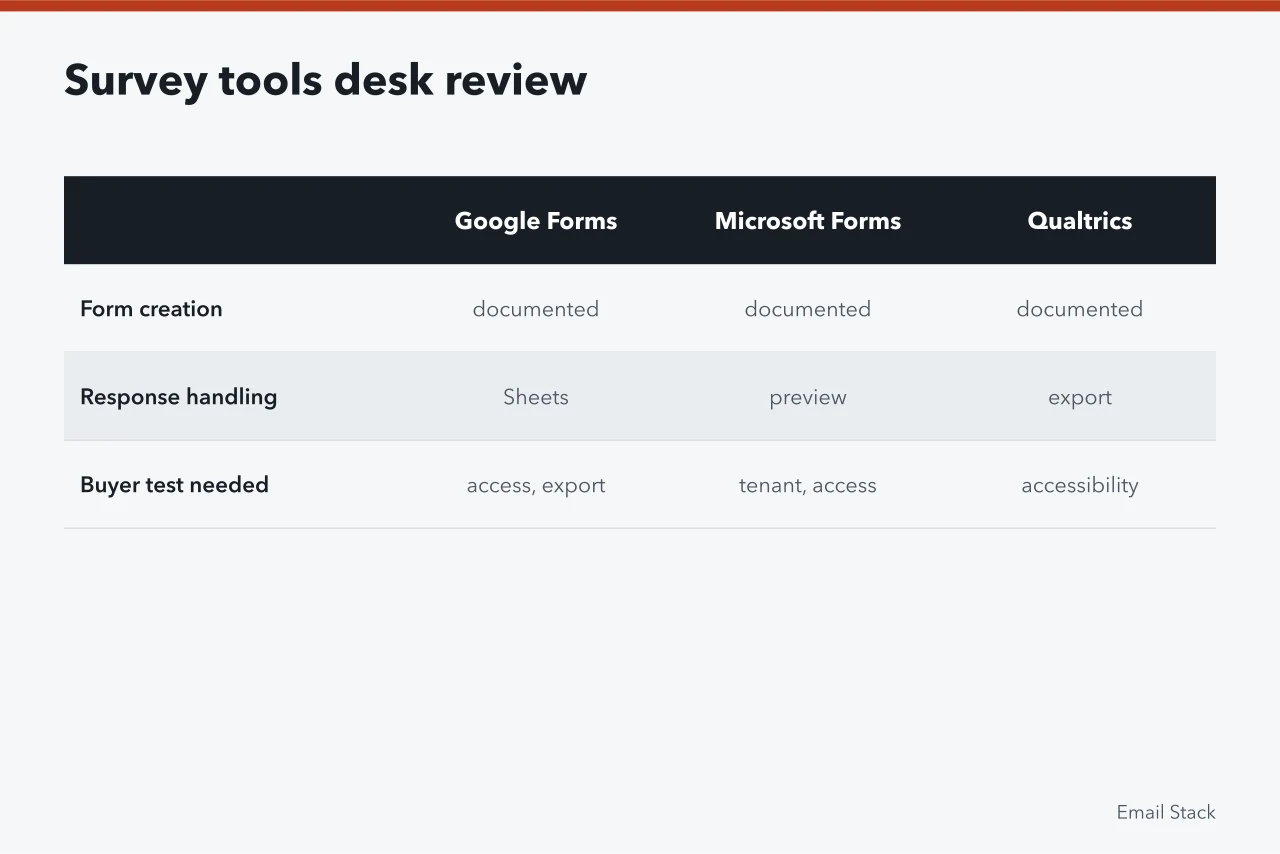
Score each test pass, fail or unknown. A tool passes only if it passes every row for your study.
| Test | Pass mark |
|---|---|
| Export | Every answer, timestamp and question identifier arrives and matches the signed data dictionary |
| Logic and quotas | A branch and a quota behave as drafted on the synthetic build, including a duplicate attempt |
| Retention and deletion | You can delete one response and its export copy, and the supplier confirms the route in writing |
| Access and roles | You can remove an administrator and see that access end |
| Accessibility | The keyboard-only, zoom and screen reader passes finish without a blocker, and any defect has a named owner and a fix-by date |
| Data location | The storage region is named by country in the contract |
Prices, panels, email-marketing suites and specialist interview tools are outside this grid. Price each tool from its own live pricing page, using your real seat and response counts.
Fix the sample before you touch a tool
The ONS survey guide standard says each survey guide covers design and implementation, including collection methods, sample design, response rates and coverage. Borrow that structure: record those fields for your own study before comparing suppliers.
A public link shared through a newsletter stays self-selected, however polished the charts look. If your study spans buyers and administrators, planning audience research around distinct populations sets out how to keep the groups apart.
Build a neutral test questionnaire with synthetic responses:
- Draft each question and route before inviting anyone.
- Check branching, duplicate handling, partial completion and timestamps.
- Compare exports against a signed data dictionary.
- Test keyboard use, zoom, screen reader output and the mobile route.
Design the research first
- Define target population and frame
- Set sampling units and sample size
- Build neutral test questionnaire
- Check branching and required questions
- Compare exports to data dictionary
- Test keyboard, zoom, screen reader, mobile
UK privacy duties for response data
Under UK GDPR you must have a valid lawful basis to handle personal information, and your organisation is usually the controller of responses with the supplier acting as processor. Record the lawful basis for the survey before the first invitation goes out.
Reusing responses for email marketing is a separate question. You must not send marketing emails to individuals without specific consent, unless a narrow exception such as the soft opt-in applies. Our guide to data protection covers roles, transfers and incidents.
The ICO's contracts and liabilities guidance is written to help controllers and processors understand what needs to be included in a contract and why. Put storage region, administrator access and deletion terms in the survey contract.
Accessibility evidence to demand
Under the Equality Act 2010 a service provider has a duty to make reasonable adjustments, and a survey of customers is part of the service you offer.
An accessibility checker on a supplier page does not prove your questionnaire works with participants' devices and assistive technologies.
Ask for a named contact who will fix an access defect, and a fix-by date in the contract. For depth rather than counts, structured customer interviews can test real campaign work with fewer participants.
Email-specific checks
The invitation is an email, so test it like one. Send it from your email stack, not from the survey tool, and check the sender name, the unsubscribe link and where replies go.
Store survey answers against a pseudonymous subscriber identifier, not the address, so the two datasets can be matched without exposing the list.
Do not add survey respondents to a marketing audience because they answered. Consent for marketing is a separate choice, recorded separately.
Example: clauses to put in the survey contract
A survey contract should settle what your privacy notice cannot. Ask for these in writing before the study opens.
Clauses to put in the survey contract
- Storage region, named by country.
- Current subprocessor list and change notice.
- Time limits for removing administrator access.
- Retention, backup and deletion terms for raw exports.
- One exit testan agreed export before term end.
The wider agreement is covered in the guide to commercial contracts.
Common questions
Which of the four tools should I pick?
The one that passes your tests at your seat and response counts. For a short questionnaire inside a suite you already administer, the built-in forms tool is the usual first test. Add logic, quotas or documented accessibility to the requirements before testing the other two.
Which UK rules cover survey responses?
UK GDPR applies, with the ICO as regulator. Your organisation is normally the controller and the supplier a processor. A respondent list is not a marketing list, and reuse needs a PECR basis.
How do I check accessibility without live participants?
Run the test build with keyboard only, at high zoom, and with a screen reader, using synthetic responses. Record the browser, device and assistive technology per pass.
What should the survey contract cover?
Storage region, subprocessor changes, administrator access removal, retention, deletion and an export test before term end.