

Audience research
Part of Planning email software audience research around four distinct populations
Researching email software competitors while keeping records, claims and reviews apart
Research email software competitors through dated, comparable evidence while keeping company records, product claims, reviews and search visibility distinct.
Email marketing software competitor research needs an evidence ledger, not a grid of unchecked claims. Preserve the entity, exact page, capture date, evidence type and comparison unit. Company filings, product pages, reviews and search results answer different questions; none alone proves market share or customer preference.
What to take away
- Keep company filings, product pages, reviews and search results in separate evidence classes, because none alone proves market share.
- Registration at Companies House cannot prove a service is trading, solvent, popular or suitable for a buyer.
- Compare the same task across suppliers rather than setting one enterprise contract against another's free-plan help page.
- Review volume and average rating must never be converted into customers, satisfaction prevalence or market share.
- Remove any comparison cell whose source cannot be reopened, and ask a second reviewer to reproduce a sample.
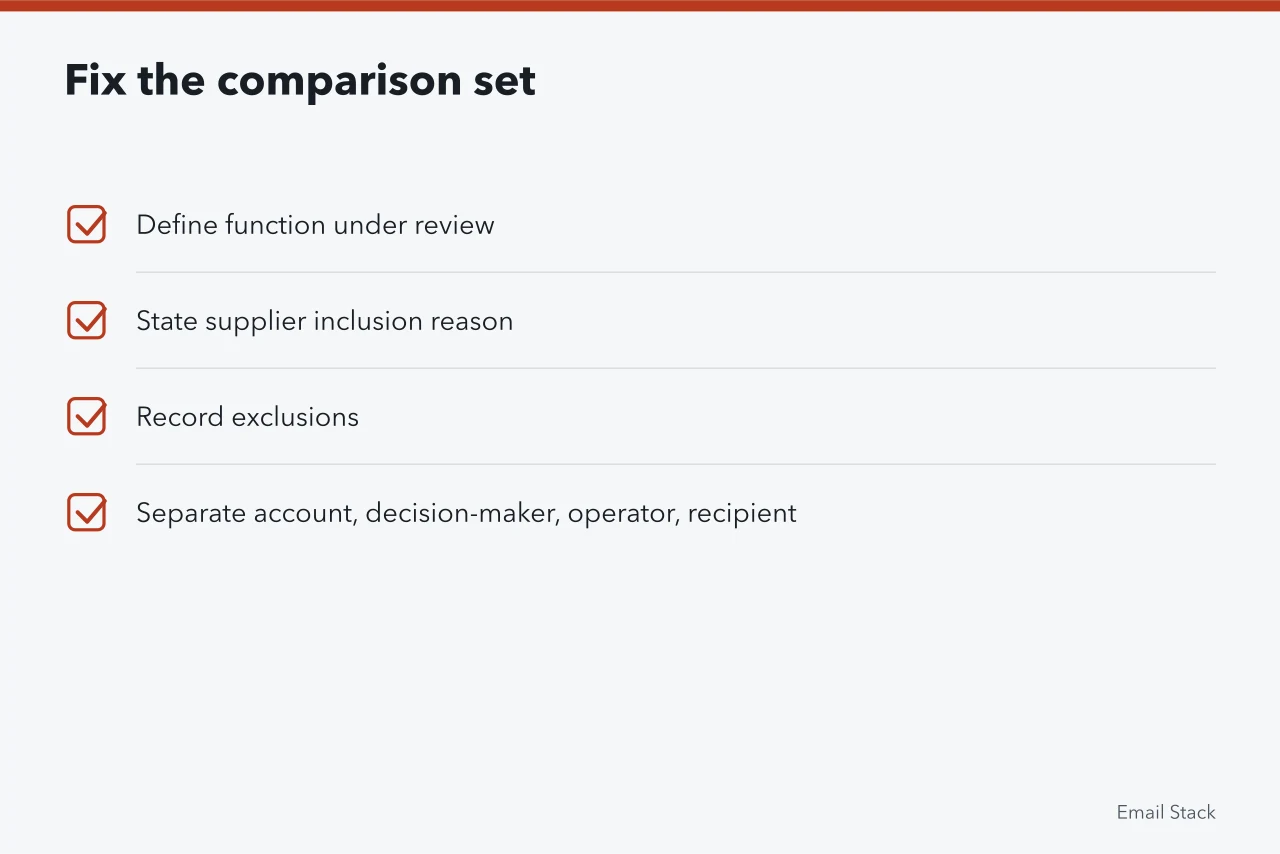
Fix the comparison set
- Define the function under review, such as campaign building, automated journeys or delivery infrastructure.
- State whether a supplier is included because it sells directly in the UK, appears in a buyer's shortlist or serves an adjacent function.
- Record exclusions, including agencies, transactional-only services or products without a current source.
- Keep the business account, decision-maker, campaign operator and recipient populations separate when interpreting evidence.
Do not call the set "the market" unless the discovery method can support that boundary. A shortlist from three interviews is evidence about those interviews, not all UK buyers.
Name the suppliers before you compare them. A UK-facing shortlist might start with Mailchimp, Klaviyo, Brevo, Dotdigital and MailerLite; an enterprise-led review might add HubSpot or Salesforce Marketing Cloud. The names are the starting point, not the finding: every one of them still needs a saved source before a comparison cell is filled.
Verify identity without inferring activity
- Save legal name, company number, registered status and filing date where a UK entity is claimed.
- Record the brand-to-entity link supplied by the business.
- Note overseas contracting entities separately.
The Companies House register search guide describes the company data and document images available without charge. Its disclaimer says the registrar does not verify or validate submitted information. Registration therefore cannot prove that a service is trading, solvent, popular or suitable.
For a UK controller, the Information Commissioner's Office register of fee payers shows whether an organisation has paid the data protection fee. The Privacy and Electronic Communications Regulations and UK GDPR set the consent and list-evidence duties that a supplier's marketing claims rest on. Neither a register entry nor a company number tells you whether the product works.
Verify identity without inferring activity
- Save legal name, company number, filing date
- Record brand-to-entity link
- Note overseas contracting entities separately
Capture product evidence consistently
- Use the supplier's current page or documentation for each material feature.
- Store page title, URL, access date, stated geography, edition and availability qualifier.
- Label screenshots and archived copies with the capture date.
- Mark unavailable information as unknown rather than filling the gap from another product.
- Separate a feature claim from proof that the feature works in a buyer's configuration.
Compare the same task across suppliers. For example, document how each source describes suppression import, role permissions and data export. Do not compare one supplier's enterprise contract with another's free-plan help page and call the difference product capability.
Capture product evidence consistently
- Use supplier's current page or documentation
- Store page title, URL, access date, geography
- Label screenshots with capture date
- Mark unavailable information as unknown
- Separate feature claim from proof
Treat reviews as a separate evidence class
- Identify the review platformG2, Capterra, Trustpilot or Gartner Peer Insights — with its collection period, eligibility and moderation policy.
- Retain the displayed count and denominator where a score is quoted.
- Note incentives, verified-purchase labels and unavailable sampling information.
- Do not convert review volume or average rating into customers, satisfaction prevalence or market share.
The Competition and Markets Authority's online consumer reviews work runs alongside the Digital Markets, Competition and Consumers Act 2024 and the Consumer Protection from Unfair Trading Regulations 2008, which prohibit misleading commercial practices. Both support caution about review evidence; neither establishes that a named software supplier manipulated reviews. Legal review is required before publishing criticism about an identifiable business.
Record search visibility without overclaiming
- Save the exact query, search engine, device, location setting, date and result type — a Google or Bing result page, for example, or an export from a rank-tracking tool such as Semrush or Ahrefs.
- Distinguish advertisements, organic pages, marketplaces and review sites.
- Repeat the capture with a documented clean method if visibility matters to the decision.
- Describe only the observed result page. Search position is not revenue, adoption or brand preference.
Treat deliverability evidence as its own class
- Log authentication and reputation dataGoogle Postmaster Tools, DMARC aggregate reports and the sending domains and IPs a supplier actually uses.
- Record seed-list placement tests by receiving mailbox provider, sending domain, date and seed list used.
- Cite published sender guidance, such as M3AAWG best practice, as guidance rather than as evidence about a named supplier's inbox placement.
Deliverability is the hardest dimension to compare, because inbox placement depends on the recipient's domain, the reputation of the specific sending domain or IP and the engagement of the list. Record a supplier's delivery or inbox-placement figure as a claim in the ledger, not as a measurement you made.
Build a claim ledger
For every cell in the final comparison, record claim | source | publisher | date | geography | [evidence class](/email-marketing-software-review-methodology) | limitation | reviewer | expiry. Give supplier claims, official records, review-platform observations and editorial judgements different labels. Remove any cell whose source cannot be reopened.
Add a comparability note before any conclusion. It should flag differences in editions, contract routes, customer types, measurement periods and missing fields.
Two pages that use the word automation may describe different triggers, channels or service responsibilities. Where source definitions do not match, present parallel descriptions instead of forcing a winner. Ask a second reviewer to reproduce a sample of entries from the saved evidence.
One worked entry makes the ledger real. Take a single task — suppressing an unsubscribed address, say — and run it across three named suppliers, such as Mailchimp, Klaviyo and Dotdigital. The claim goes in the claim field, the help-page URL and its publisher in the source field, the access date in the date field, the geography the page was served to in the geography field, product page in the evidence class, and the gap between a documented feature and a tested behaviour in the limitation field. A reader can then reopen every source and see exactly what was compared.
The next step is to audit one buying task across a small, disclosed set of suppliers. Stop publication if identities remain ambiguous, editions are not comparable or a review and search count is doing the work of market evidence.
Before you act
- Define the function under review before fixing the comparison set.
- Record exclusions such as agencies and transactional-only services.
- Save legal name, company number and filing date for UK entities.
- Label screenshots and archived copies with the capture date.
- Note review platform, collection period, eligibility and moderation policy.
- Give each claim a source, date, evidence class and limitation.
Common questions
Why is a shortlist from three interviews not the market?
The article says a shortlist from three interviews is evidence about those interviews, not all UK buyers. Do not call the set the market unless the discovery method can support that boundary. Record whether a supplier is included because it sells directly in the UK, appears on a buyer's shortlist or serves an adjacent function.
What does the Companies House disclaimer mean for supplier checks?
The registrar does not verify or validate submitted information, so registration cannot prove that a service is trading, solvent, popular or suitable. Save the legal name, company number, registered status and filing date where a UK entity is claimed, and note overseas contracting entities separately.
How should reviews be handled in competitor research?
Treat reviews as a separate evidence class. Identify the platform, collection period, eligibility and moderation policy, and retain the displayed count and denominator where a score is quoted. Note incentives and verified-purchase labels. Do not convert review volume or average rating into customers, satisfaction prevalence or market share.