

Measurement
Part of An email reporting run, from reconciled send to logged release
What rule-based, observational and experimental email attribution can each claim
Compare email attribution rules, observational analysis and experiments by question, assumptions, data, uncertainty and strength of causal interpretation.
Email marketing software attribution methods answer allocation questions unless the design supplies a credible counterfactual. A provider's last-click label can describe its rule; it cannot establish what would have happened without the email.
This comparison was prepared on 5 September 2026 for an organisation operating in England. No provider was selected and no data was analysed. The methods are unranked because suitability depends on the decision, lawful data access and feasible design.
What to take away
- Rule-based attribution describes how a system assigns recorded actions.
- Observational models can adjust for recorded differences but unmeasured selection may remain, so report association when causal assumptions fail.
- Randomised designs define treatment and comparison before outcomes are known, but ethical, legal and operational constraints may rule them out.
- Keep allocation output and impact estimates in separate report fields.
- Pre-register the primary outcome and stop condition, and show estimates with uncertainty and failed quality checks.
Compare on common criteria
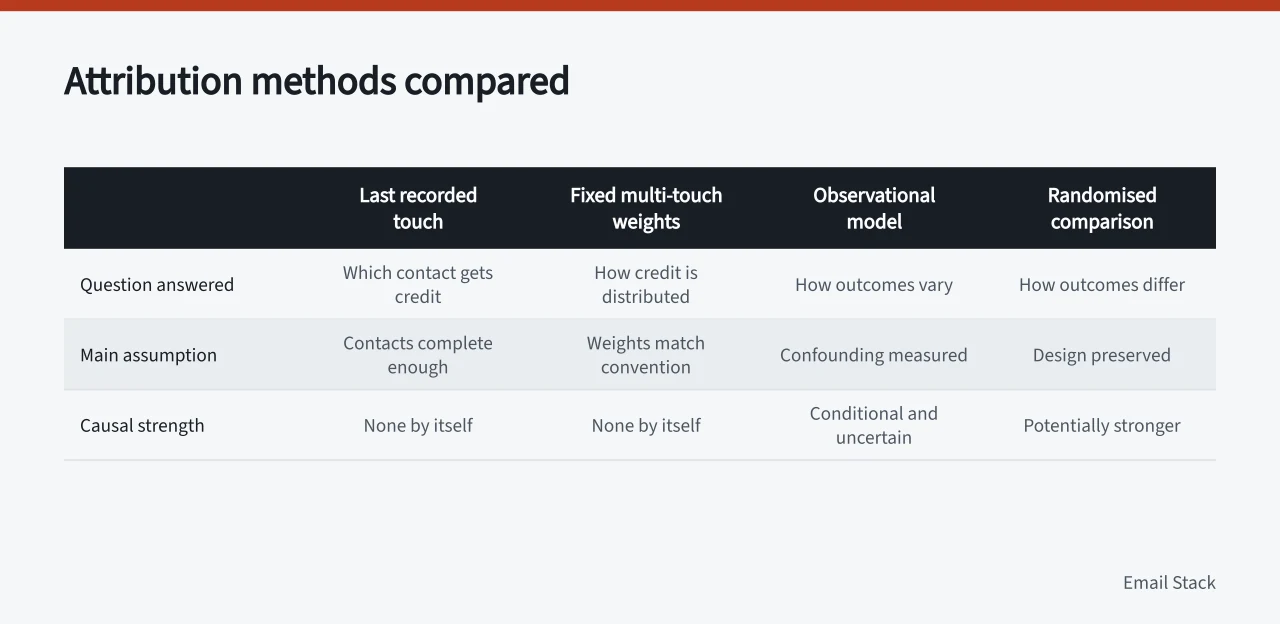
Read the causal strength column as a ceiling on what each design can claim, not as a measure of how precise its number looks. The other columns set the conditions attached to rule-based, observational and experimental email attribution.
Question answered
- Last recorded touch
- which observed contact receives allocation
- Fixed multi-touch weights
- how credit is distributed under chosen weights
- Observational model
- how outcomes vary with recorded exposure and controls
- Randomised comparison
- how outcomes differ under assigned intervention and comparison
Main assumption
- Last recorded touch
- tracked contacts are complete enough for the rule
- Fixed multi-touch weights
- weights represent the intended convention
- Observational model
- important confounding is measured and modelled adequately
- Randomised comparison
- allocation, follow-up and analysis preserve the design
Causal strength
- Last recorded touch
- none by itself
- Fixed multi-touch weights
- none by itself
- Observational model
- conditional and uncertain
- Randomised comparison
- potentially stronger when valid
For every method state population, treatment, comparison, outcome, unit, period, timezone, source systems, identity rules, exclusions, missing data, owner and uncertainty. Use the same contribution and cost definitions if a financial decision follows.
Rule-based allocation
Last-touch and weighted models are reproducible when the event sequence, observation window and tie rules are fixed. They are useful for describing how a system assigns recorded actions. Results can change when redirects, identifiers, other channels or privacy settings change.
The ICO's storage and access technology guidance makes the tracking mechanism a separate compliance question. Do not collect extra identifiers merely to make attribution appear complete.
Observational analysis
An observational comparison may adjust for recorded differences between exposed and unexposed groups. It must name the confounders, model form, overlap, missingness, timing and sensitivity tests. Unmeasured selection can remain. Report association when the assumptions cannot support a causal interpretation.
A minimal viable confounder set for email includes prior purchase, list tenure and send frequency, with engagement recency as a fourth candidate where it is recorded.
Worked example: a logistic model of conversion on opened versus not opened, adjusted for those fields, tested with a sensitivity run that adds a term for unmeasured selection. If the estimate moves materially when that term is added, publish the association only.
The ICO's data-protection principles guide includes data minimisation. An analytically useful field still needs a defined purpose, lawful handling, access and retention.
Experimental comparison
A randomised holdout or other prospective design defines treatment and comparison before outcomes are known. Record allocation unit, eligibility, contamination, non-compliance, attrition, outcome window and analysis plan. Ethical, legal and operational constraints may rule out a design.
In email software, allocate at the subscriber level before send and exclude holdout contacts from every send and suppression rule for the test window. Check contamination by comparing open and click rates between groups before analysis. Typical practice holds back 5 to 10 per cent of the eligible send.
The 2026 Magenta Book explains impact evaluation in government and discusses causal designs. It does not provide a ready-made email experiment or validate commercial claims.
The Magenta Book's quality guidance states that random allocation is the strongest form of design for an impact evaluation. That ranking applies to the design's ability to support causal claims, not to the precision of any single estimate or to the feasibility of running the design in a given setting.
Appraise the decision, not the prettiest result
The Green Book 2026 covers sensitivity, opportunity cost and optimism bias for public appraisal. A commercial team can use those disciplines while retaining its own scope and assumptions.
The worked example below uses illustrative figures only. A campaign reports 4,000 last-click conversions and £120,000 of attributed revenue. A 10 per cent randomised holdout implies about 2,800 incremental conversions, or £84,000. Report both: one is an allocation figure, the other an impact estimate.
Keep the allocation output and impact estimate in different report fields. For each, name the currency or outcome unit, observation period, eligible population, numerator, denominator, costs included, refunds and late outcomes. A finance controller should define contribution and tax treatment; an evaluator should approve any causal language. Neither should inherit the provider's label without checking its definition.
Pre-register the primary outcome and stop condition. Show estimates with uncertainty, failed quality checks and alternative assumptions. If a rule-based figure and an experimental estimate differ, do not average them: explain that they answer different questions and let the analytics lead decide which evidence fits the decision.
Before you act
Before you act
- State population, treatment, comparison, outcome, unit, period
- Define contribution and cost consistently
- Name confounders, model form, overlap, missingness, timing
- Record allocation unit, eligibility, contamination, attrition
- Name currency, numerator, denominator, costs, refunds
- Have evaluator approve causal language
- Name the decision the result will inform, and the owner who will act on it.
- Fix population, outcome and period before any data is pulled.
- Write the confounder list and sensitivity test into the plan before fitting.
- Set the allocation unit and contamination checks before the first send.
- Have the finance controller sign off contribution and cost definitions.
- Have the analytics lead approve causal language before publication.
Common questions
What does a last-click label actually establish?
It fixes how credit is allocated under a stated rule. Treat it as an allocation figure, not an impact estimate, and expect it to move when redirects, identifiers, other channels or privacy settings change.
When can an observational comparison support a causal claim?
An observational comparison may adjust for recorded differences between exposed and unexposed groups, but it must name confounders, model form, overlap, missingness, timing and sensitivity tests. Unmeasured selection can remain. Report association when the assumptions cannot support a causal interpretation, because causal strength is conditional and uncertain.
What should happen if a rule-based figure and an experimental estimate differ?
Report both, since they answer different questions. The analytics lead decides which evidence fits the decision, and the finance controller sets contribution and tax treatment while an evaluator approves any causal language.